
|
Getting your Trinity Audio player ready...
|
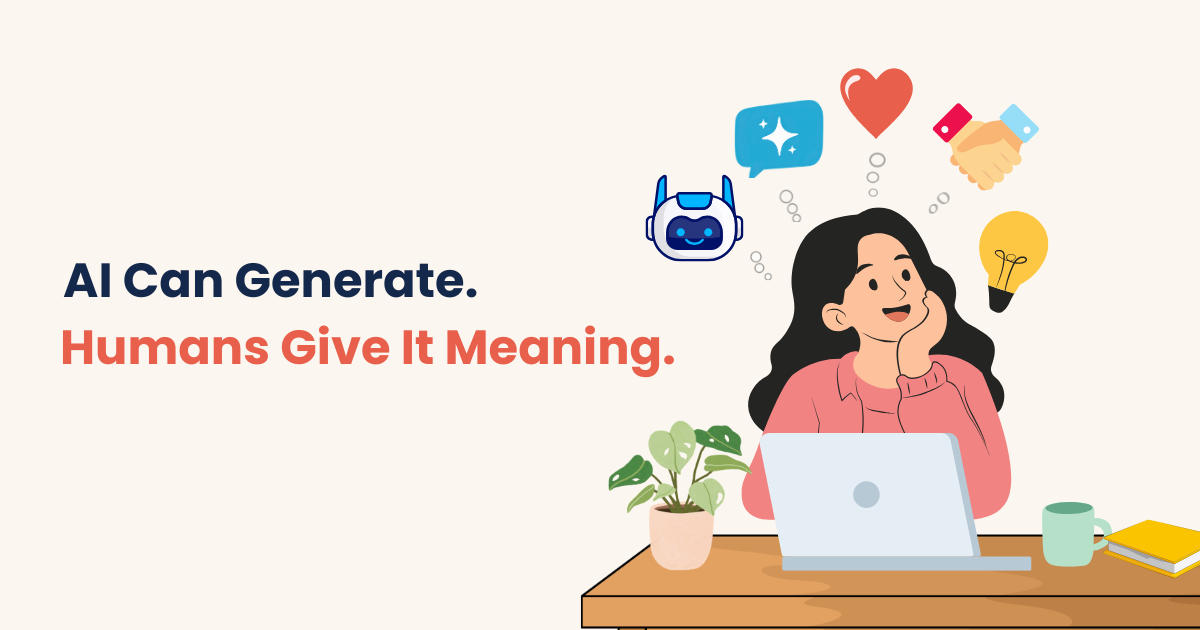
A few weeks ago, I came across two small grocery shops promoting their products on Instagram. Both sold farm-fresh fruits and vegetables. But one of them didn’t make much of an impact on me. It was clear that their content was made only using AI, without any real human touch or input.
The other one made me stop scrolling, and I actually ended up buying their products. They showed everyday moments and a genuine human connection that I could instantly relate to. That made me wonder what really makes the difference.
From writing captions and designing posters to creating entire videos for social media ads, AI is literally everywhere and has quietly become a part of how many businesses market themselves. What I feel is that AI is definitely useful in the world of digital marketing and has changed the way businesses work. But the human touch is still very much essential. Humans who can give a brand that extra edge are highly sought after and cannot be replaced by AI.
Humans should use technology for their benefit and for ease of work, but it can never replace precious human thinking. So where exactly does AI help, and where does the human touch make all the difference? In this blog, I want to share my perspective on this, especially for small business owners.
Marketing has always been about people
At its core, marketing is about understanding people’s emotions and needs, and it is also about empathy. Think of a restaurant where a waiter remembers your favourite dish even before you order it. That personal attention is what kept customers loyal, long before any algorithms existed.
Human beings bring a personal touch that AI lacks, because it can’t feel or share human experiences. It can tell you what a happy customer looks like on paper, but it has never felt the joy of finding the perfect gift or the happy surprise of a parcel arriving earlier than expected. We have all felt these little joys, and that is what helps us connect with other people.
Where AI truly helps
As much as I value the human touch, I must admit that AI has made a lot of work easier. AI is great at handling the routine tasks that take up so much of our time. It helps in understanding customer preferences, buyer history and customer demographics, and tailors recommendations to each customer. AI has also made professional-looking posters, short videos and product visuals more affordable and easier for small businesses to create.
AI, together with other smart technologies, is also useful in creating interactive and immersive experiences for customers and providing real-time suggestions in many fields, such as interior design, skincare, jewellery, eye care and more. Imagine trying on a pair of glasses virtually or seeing how a sofa looks in your living room before buying it. These are wonderful experiences, and AI helps make them possible.
For a small business owner with limited time and a small team, this also means fewer repetitive questions to answer and fewer returns to handle, because customers can see and decide for themselves.
AI learns from the past, humans imagine what’s next
But there is one thing to understand. AI does all this based on information that already exists. Even when it predicts trends, it is only working from patterns of the past, not from a vision of what could be. AI can give you general information from what it has learned, but it cannot give you a new perspective or approach. That is only in the hands of a human.
This is where human creativity comes in. It means imagining something that doesn’t exist yet, like a fresh idea for a campaign, an unexpected way to present a product, or a message that makes people smile. AI can mix and rearrange what it has seen before, but a truly new idea usually begins with a human thought.
When AI is used without thought, every brand will sound the same
If everyone uses AI just for the sake of using it, without giving it proper thought or input, every brand will look and feel the same. Each brand has its own personality and its own way of speaking to its customers, called its brand tone or brand voice. This is what sets it apart from its competitors and makes it unique. AI should be used thoughtfully if it is to make a difference, and in this aspect, a digital marketer plays a vital role.
Let’s imagine a wedding cake baker who creates specialised, custom-made cakes. The mouth-watering, sensory experience of the taste and texture of the cake cannot be felt or expressed by AI. It can write well and provide information based on what we ask or input, but it cannot describe the uniqueness and the flavour of the cake like a human does.
A human can describe the soft layers, the hint of vanilla, or the couple’s smile when they first saw their cake, because a human has actually tasted it and experienced it. These little details are the baker’s own voice and what makes a customer choose her cakes over every other bakery in town.
If this baker simply asks AI to promote her business, without adding her own input or experience, it will not catch people’s attention, and the emotional connection will definitely be missing. I believe that if a business aims to stand out from the rest, then humans should be at the heart of its digital marketing.
Humans give a brand an edge
The second shop I mentioned in the introduction, a small farm-to-home business, marketed their products meticulously by creating a relatability factor with people. They showed real-life scenarios of how their flexible delivery schedule made the busy morning chaos and the tired after-work evenings easier. They also used AI effectively to create avatars during festivals to promote their festive bundles, but they did not solely rely on it. This created instant trust and a bond with their customers.
When I think back, both shops sold good products. The difference was that one let AI do all the talking, while the other used AI as a helper and kept real people and real life at the centre. That genuine and natural approach attracted me, and I simply wanted to buy from them.
Cultural understanding in marketing comes from people
AI can write articles, blogs and content for a business. But can it include the tone, the subtle details and the unique human experiences that make content engaging and interesting to read?
All over the world, there are different cultures, different values, different festivals and different languages. Knowing about a culture is one thing. Truly understanding it comes from experiencing it.
AI does not have an upbringing like a human does. It learns from information, not from people, and it has not lived its own experiences of life. Representing a culture appropriately and respecting its values needs a deep cultural understanding. That is something only a human can bring to marketing.
Storytelling needs a human heart
Storytelling is one of the most meaningful ways in which a brand connects with its audience. It requires human understanding, emotions and empathy to truly move people. One cannot simply ask AI to generate a script with characters and a plot, and call it a story.
When it comes to marketing, a story should grab attention quickly, feel close to people’s own lives, and echo the brand’s vision. AI can help with the research and structuring part of it, but the other aspects can only be fulfilled by humans. The best brand stories often come from honest moments, like why the founder started the business, the first customer who believed in them, or a problem they solved for someone. A story with a soulful touch stays in people’s minds, and so does the brand behind it.
How to balance AI and the human touch
AI is efficient when handling large amounts of data. It can help you repurpose content for different platforms, get a rough draft ready and study patterns and customer behaviour to show you what performs best. Automated replies to comments are also extremely helpful and save a lot of time.
But AI can sound very confident even when it is not right. It can get facts wrong, make up details, or say something that doesn’t suit your brand at all. So whatever AI creates, a human needs to review it before it goes out, to make sure it is accurate, honest and true to the brand.
Apart from checking what AI creates, some parts of marketing should always be done by people. The human touch is mandatory to create a meaningful impact on the audience. Show your team at work, a candid moment from your workplace, or how your product is made, and share real-life stories that touch people’s hearts.
Even with automated replies in place, occasionally make it a point to interact with customers through comments and reply to messages personally. A personalised, handwritten thank-you note sent along with the order, or a kind response to a complaint, increases trust and helps build a personal connection.
AI is a tool, not a replacement for humans
So, is AI good or bad for marketing? I don’t think it is either. It is a tool, and like any tool, what matters is how we use it. Using AI wisely is the way to go. The gap between what AI can do and what humans can do should be handled with care, because that is exactly where a business can stand out.
Personally, I trust brands that prefer a human touch in marketing their products or services. I think many customers feel the same way. After all, people buy from people they trust, and that trust is built by humans.